PHOTOGRAPH #253 · clusters
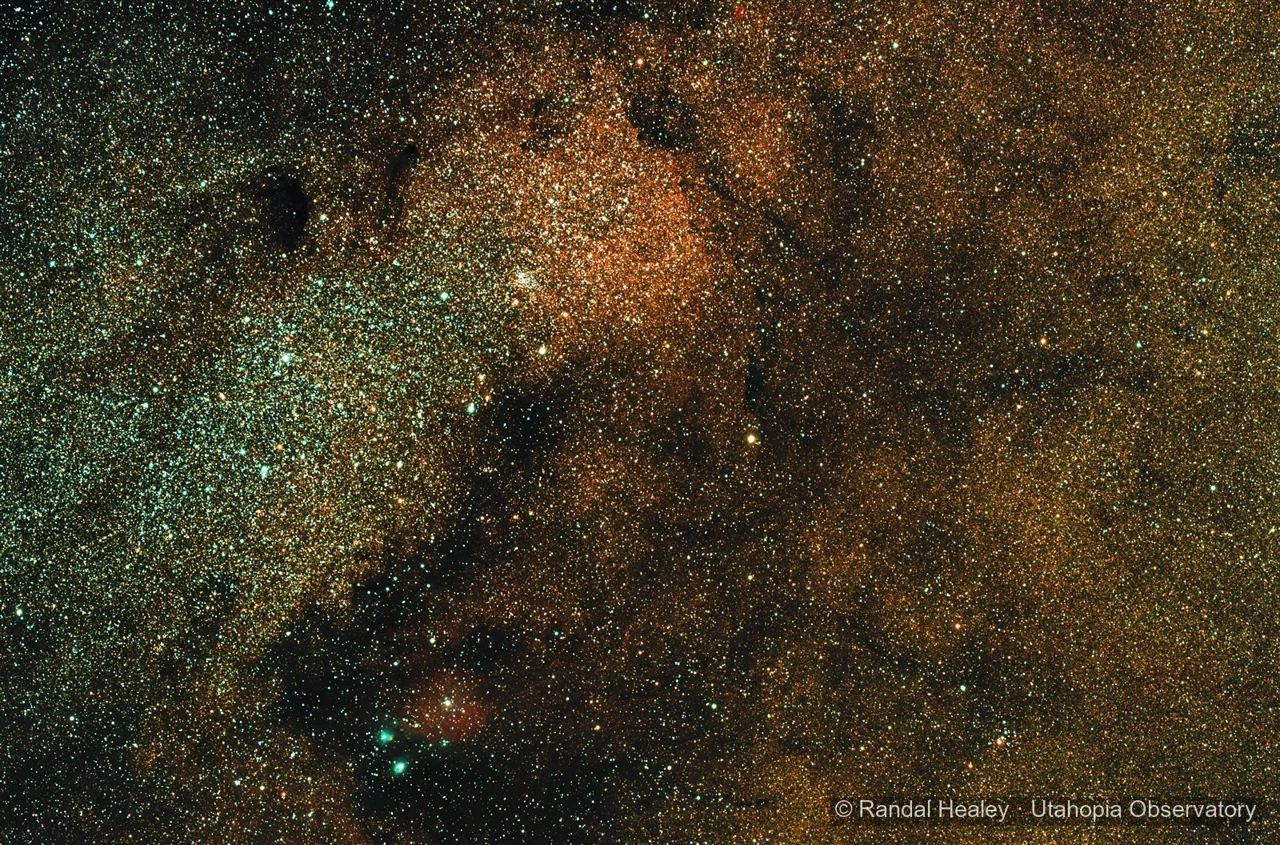
M24 Starfield
Randal Healey · Utahopia Observatory
The Sagittarius Star Cloud (also known as Messier 24 and IC 4715) is a star cloud in the constellation of Sagittarius, approximately 600 light years wide, which was discovered by Charles Messier in 1764.
The stars, clusters and other objects comprising M24 are part of the Sagittarius or Sagittarius-Carina arms of the Milky Way galaxy. Messier described M24 as a "large nebulosity containing many stars" and gave its dimensions as being some 1.5° across.
M24 fills a space of significant volume to a depth of 10,000 to 16,000 light-years. This is the most dense concentration of individual stars visible using binoculars, with around 1,000 stars visible within a single field of view.
The star cloud M24 holds a collection of numerous kinds of stars that are placed along the Milky Way and through the galaxy's obscuring band of interstellar dust.
HD 167356 is the brightest star that is located within the Sagittarius Star Cloud, a white supergiant with an apparent magnitude of 6.05.
The star cloud incorporates two prominent dark nebulae which are vast clouds of dense, obscuring interstellar dust. This dust blocks light from the more distant stars, which keeps them from being seen from Earth.
Original description & acquisition details ↗The stars, clusters and other objects comprising M24 are part of the Sagittarius or Sagittarius-Carina arms of the Milky Way galaxy. Messier described M24 as a "large nebulosity containing many stars" and gave its dimensions as being some 1.5° across.
M24 fills a space of significant volume to a depth of 10,000 to 16,000 light-years. This is the most dense concentration of individual stars visible using binoculars, with around 1,000 stars visible within a single field of view.
The star cloud M24 holds a collection of numerous kinds of stars that are placed along the Milky Way and through the galaxy's obscuring band of interstellar dust.
HD 167356 is the brightest star that is located within the Sagittarius Star Cloud, a white supergiant with an apparent magnitude of 6.05.
The star cloud incorporates two prominent dark nebulae which are vast clouds of dense, obscuring interstellar dust. This dust blocks light from the more distant stars, which keeps them from being seen from Earth.
Ask about this photograph ↗
Every order includes a personally signed certificate of authenticity and print number. Image proportions and suitable print sizes are confirmed before production.