PHOTOGRAPH #239 · galaxies
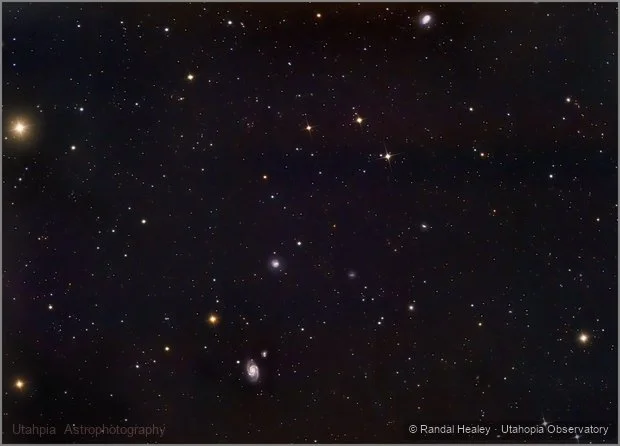
NGC3893, and The Miniature Spiral Galaxy NGC 3982 and Their Friends
Randal Healey · Utahopia Observatory
NGC 3982 is a galaxy that spans about 30,000 light-years, about one-third of the size of our Milky Way galaxy. The galaxy is receding from us at about 1109 km/s. The galaxy is a typical spiral galaxy, similar to our Milky Way. It harbors a supermassive black hole at its core and has massive regions of star formation in the bright blue knots in the spiral arms. Supernovae are likely to be found within these regions.
NGC 3982 has a high rate of star birth within its arms, which are lined by pink star-forming regions of glowing hydrogen and newborn blue star clusters. Its bright nucleus is home to older populations of stars, which grow more densely packed toward the center. The galaxy also has active star formation in the circumnuclear region.
NGC 3982 is a member of the M109 Group, a group of galaxies located in the constellation Ursa Major that may contain over 50 galaxies. The group was named after the brightest galaxy in the group, the spiral galaxy M109.
Astronomers are interested in studying this galaxy as it can help in measuring extragalactic distances. It is helpful because it possesses two tools used to estimate astronomical distances: a stellar explosion, or supernova; and Cepheid variable stars.
Original description & acquisition details ↗NGC 3982 has a high rate of star birth within its arms, which are lined by pink star-forming regions of glowing hydrogen and newborn blue star clusters. Its bright nucleus is home to older populations of stars, which grow more densely packed toward the center. The galaxy also has active star formation in the circumnuclear region.
NGC 3982 is a member of the M109 Group, a group of galaxies located in the constellation Ursa Major that may contain over 50 galaxies. The group was named after the brightest galaxy in the group, the spiral galaxy M109.
Astronomers are interested in studying this galaxy as it can help in measuring extragalactic distances. It is helpful because it possesses two tools used to estimate astronomical distances: a stellar explosion, or supernova; and Cepheid variable stars.
Ask about this photograph ↗
Every order includes a personally signed certificate of authenticity and print number. Image proportions and suitable print sizes are confirmed before production.