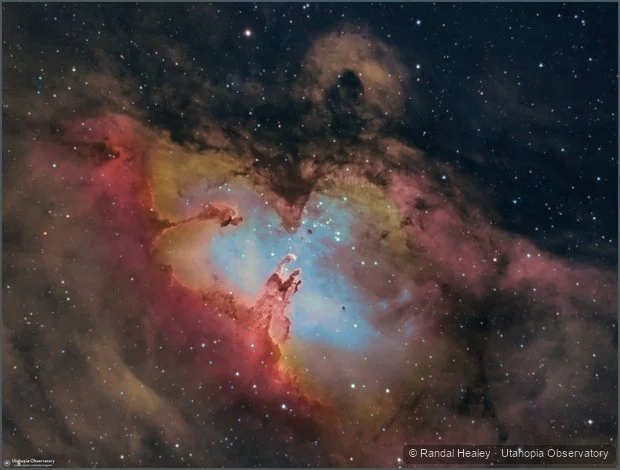
PHOTOGRAPH #131 · nebulae
M16 Eagle Nebula (Pillars of Creation)
Randal Healey · Utahopia Observatory
"The Eagle Nebula" is part of a diffuse emission nebula, This region of active current star formation is about 7000 light-years distant. A spire of gas that can be seen coming off the nebula is approximately 9.5 light-years or about 90 trillion kilometers long.
The cluster associated with the nebula has approximately 8100 stars, which are mostly concentrated in a gap in the molecular cloud to the north-west of the Pillars. The brightest star (HD 168076) has an apparent magnitude of +8.24, easily visible with good binoculars. It is actually a binary star. This star has a mass of roughly 80 solar masses, and a luminosity up to 1 million times that of the Sun. The cluster's age has been estimated to be 1–2 million years.
"Pillars of Creation" region. The pillar structure of the region resembles that of a much larger star formation region in the Soul Nebula of Cassiopeia and characterized as "Pillars of Star Creation". or "Pillars of Star Formation". These columns – which resemble stalagmites protruding from the floor of a cavern – are composed of interstellar hydrogen gas and dust, which act as incubators for new stars. Inside the columns and on their surface astronomers have found knots or globules of denser gas, called EGGs ("Evaporating Gaseous Globules"). Stars are being formed inside some of these EGGs.
Original description & acquisition details ↗The cluster associated with the nebula has approximately 8100 stars, which are mostly concentrated in a gap in the molecular cloud to the north-west of the Pillars. The brightest star (HD 168076) has an apparent magnitude of +8.24, easily visible with good binoculars. It is actually a binary star. This star has a mass of roughly 80 solar masses, and a luminosity up to 1 million times that of the Sun. The cluster's age has been estimated to be 1–2 million years.
"Pillars of Creation" region. The pillar structure of the region resembles that of a much larger star formation region in the Soul Nebula of Cassiopeia and characterized as "Pillars of Star Creation". or "Pillars of Star Formation". These columns – which resemble stalagmites protruding from the floor of a cavern – are composed of interstellar hydrogen gas and dust, which act as incubators for new stars. Inside the columns and on their surface astronomers have found knots or globules of denser gas, called EGGs ("Evaporating Gaseous Globules"). Stars are being formed inside some of these EGGs.
Ask about this photograph ↗
Every order includes a personally signed certificate of authenticity and print number. Image proportions and suitable print sizes are confirmed before production.