PHOTOGRAPH #100 · nebulae
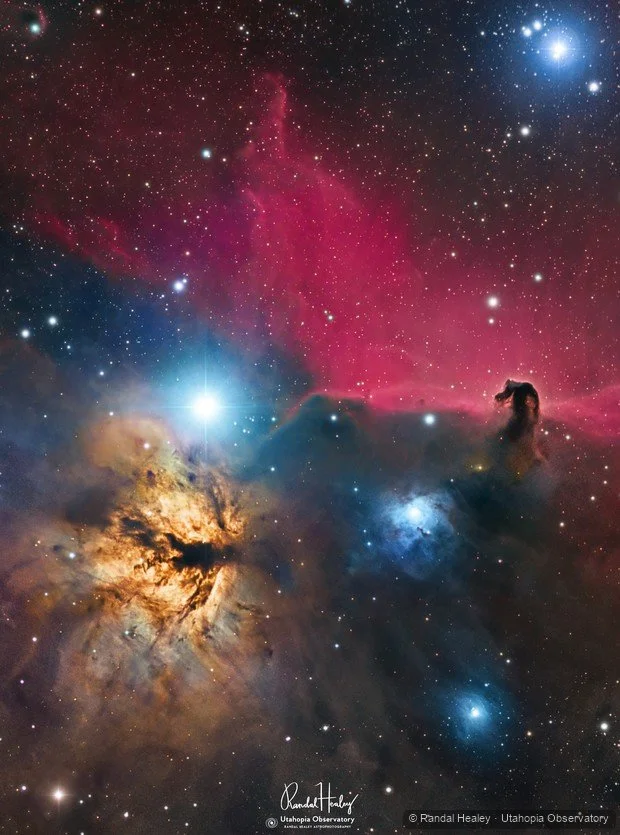
The Horsehead and Flame Nebulas
Randal Healey · Utahopia Observatory
The Horsehead Nebula (also known as Barnard 33)
The Horsehead nebulae is a dark nebula in the constellation Orion. The nebula is located just to the south of the star Alnitak, which is farthest east on Orion's Belt, and is part of the much larger Orion Molecular Cloud Complex. The Horsehead Nebula is approximately 1500 light years from Earth. It is one of the most identifiable nebulae because of the shape of its swirling cloud of dark dust and gases, which bears some resemblance to a horse's head when viewed from Earth.
The Flame Nebula, designated as NGC 2024 and Sh2-277,
This is an emission nebula in the constellation Orion. The bright star Alnitak, the easternmost star in the Belt of Orion, shines energetic ultraviolet light into the Flame and this knocks electrons away from the great clouds of hydrogen gas that reside there. Much of the glow results when the electrons and ionized hydrogen recombine. Additional dark gas and dust lies in front of the bright part of the nebula and this is what causes the dark network that appears in the center of the glowing gas. The Flame Nebula is part of the Orion Molecular Cloud Complex, a star-forming region that includes the famous Horsehead Nebula.
At the center of the Flame Nebula is a cluster of newly formed stars, 86% of which have circumstellar disks. X-ray observations by the Chandra X-ray Observatory show several hundred young stars, out of an estimated population of 800 stars. X-ray and infrared images indicate that the youngest stars are concentrated near the center of the cluster.
Original description & acquisition details ↗The Horsehead nebulae is a dark nebula in the constellation Orion. The nebula is located just to the south of the star Alnitak, which is farthest east on Orion's Belt, and is part of the much larger Orion Molecular Cloud Complex. The Horsehead Nebula is approximately 1500 light years from Earth. It is one of the most identifiable nebulae because of the shape of its swirling cloud of dark dust and gases, which bears some resemblance to a horse's head when viewed from Earth.
The Flame Nebula, designated as NGC 2024 and Sh2-277,
This is an emission nebula in the constellation Orion. The bright star Alnitak, the easternmost star in the Belt of Orion, shines energetic ultraviolet light into the Flame and this knocks electrons away from the great clouds of hydrogen gas that reside there. Much of the glow results when the electrons and ionized hydrogen recombine. Additional dark gas and dust lies in front of the bright part of the nebula and this is what causes the dark network that appears in the center of the glowing gas. The Flame Nebula is part of the Orion Molecular Cloud Complex, a star-forming region that includes the famous Horsehead Nebula.
At the center of the Flame Nebula is a cluster of newly formed stars, 86% of which have circumstellar disks. X-ray observations by the Chandra X-ray Observatory show several hundred young stars, out of an estimated population of 800 stars. X-ray and infrared images indicate that the youngest stars are concentrated near the center of the cluster.
Ask about this photograph ↗
Every order includes a personally signed certificate of authenticity and print number. Image proportions and suitable print sizes are confirmed before production.